Ordering custom metal zippers from China is one of the highest-ROI procurement decisions a B2B buyer can make — but only if you get the specification and sourcing process right. A miscommunication on gauge size, a vague finish description, or skipping the sample stage can turn a $0.15/unit deal into a $15,000 write-off. This guide walks you through every step, from writing your first RFQ to receiving your shipment.
Garment manufacturers, bag and luggage brands, outdoor gear producers, furniture upholstery buyers, and any B2B purchaser sourcing 500–50,000+ custom metal zippers from Chinese suppliers.
Step 1: Nail Your Specification Before Contacting Suppliers
The single biggest mistake B2B buyers make? Sending a supplier a photo and saying "I need something like this." Without a written specification, you'll get whatever the factory has in stock — not what your product actually needs.
| Field | Options / Values | Why It Matters |
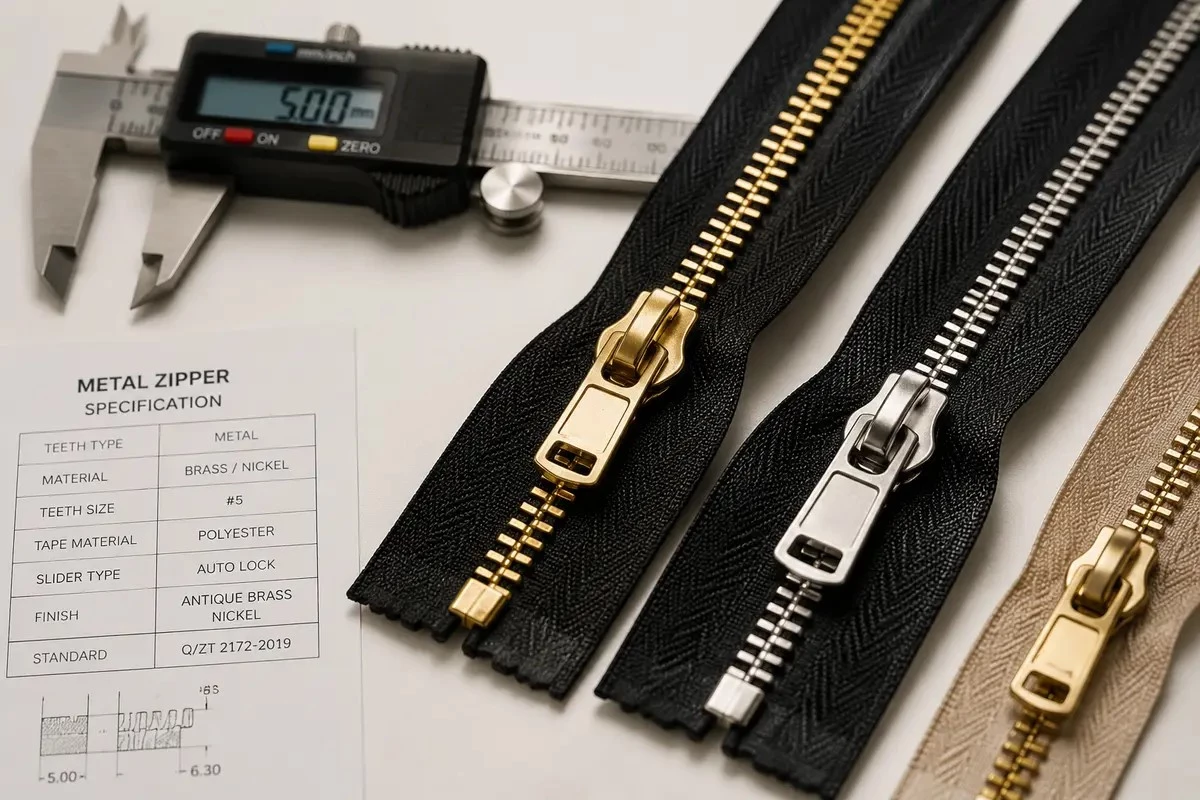
| 1. Gauge (#) | #3, #5, #7, #8, #10 | Determines tooth size & strength. #5 for trousers, #8 for bags, #10 for heavy luggage |
| 2. Teeth Material | Brass / Aluminum / Zinc Alloy | Brass = premium; Aluminum = lightweight; Zinc Alloy = best for custom electroplating |
| 3. Finish / Color | Nickel, Antique Brass, Gunmetal, Gold, etc. | Must match your product's hardware. Always ask for a finish swatch card |
| 4. Slider Type | Auto-Lock / Non-Lock / Pin-Lock / Reversible | Auto-lock for trousers; non-lock for internal pockets; reversible for jackets |
| 5. Puller | Material + Length (mm) + Finish | Custom logo puller requires mold investment ($200–$500) |
| 6. Tape Color & Width | Pantone code + width (mm) | Standard: 24mm for #5, 30mm for #8. Polyester tape preferred for durability |
| 7. Length | From top stop to bottom stop (cm) | Custom lengths add 3–5 days to production vs. standard stock lengths |
| 8. End Type | Closed-End / Open-End / Two-Way | Closed-end for bags/pockets; Open-end (separating) for jackets/coats |
Step 2: Understand MOQ, Pricing & Quantity Tiers
Chinese zipper factories operate on volume economics. Here's what to expect at each quantity tier:
Sample / Trial Order
Qty: 50–500 pcs
Unit Price: $0.30–$1.00
Lead Time: 7–15 days
Free samples common (you pay shipping). Expect higher per-unit cost.
Small Batch
Qty: 1,000–5,000 pcs
Unit Price: $0.12–$0.40
Lead Time: 15–25 days
MOQ for custom finishes and colors. Standard pullers only at this tier.
Bulk Production
Qty: 10,000–50,000+ pcs
Unit Price: $0.06–$0.20
Lead Time: 20–35 days
Custom mold investment amortized. Best per-unit economics.
Pricing factors that move the needle: Gauge size (larger = more metal = higher cost), teeth material (brass costs 2–3x aluminum), finish complexity (gunmetal and antique finishes require extra plating steps), and custom puller molds (one-time $200–$500, but drops per-unit cost to near zero after 10,000 units).
Step 3: The Sampling Process — Never Skip This
Sampling is the single most important quality gate in your procurement workflow. A supplier that resists providing samples — or charges unreasonably for them — is a red flag.
- Pre-Production Sample (PPS): Supplier produces 5–10 zippers to your exact spec. You inspect for visual quality, dimensions, color match, and slider operation. Timeline: 7–10 days.
- Golden Sample Approval: Once you approve the PPS, sign and return one sample as the "golden standard." This becomes the reference for the entire production run. Both you and the supplier keep a copy.
- Production Sample (optional): For orders over 10,000 units, request 3–5 random samples pulled from the first day of production. This catches any deviation before the full batch is completed.
What to inspect on samples: Tape color against your Pantone reference, slider pull-off force (should not detach under 15N), tooth alignment (no gaps or uneven spacing), finish consistency (no blotching or color variation), and stop crimping tightness (no movement when pulled).
Step 4: Quality Control & Inspection Standards
Don't rely on the supplier's word. Build QC into your contract from day one.
In-House QC (Supplier)
Insist on suppliers with ISO 9001 certification. Ask for their QC checklist: raw material inspection → in-process checks → final random sampling. A good factory inspects every 500 units during production.
Third-Party Inspection
For orders over $5,000, budget $200–$300 for SGS, Bureau Veritas, or Intertek inspection. They'll check AQL 2.5 sampling, tensile strength, salt spray resistance, and dimensional accuracy.
Key test standards to reference in your contract: QB/T 2171–2173 (Chinese national zipper standard), ASTM D2061 (US standard for zipper strength), BS 3084 (UK zipper specification). Specify that tensile strength must be ≥500N for #5 and ≥700N for #8 zippers.
Step 5: Lead Times, Shipping & Logistics
Production lead times are just one piece of the puzzle. Total timeline = production + QC + freight + customs clearance.
| Raw material preparation | 3–5 days |
| Production (standard order) | 12–20 days |
| In-house QC + packing | 2–3 days |
| Third-party inspection (if booked) | 1–2 days |
| Sea freight (China → US/EU) | 15–30 days |
| Air freight (express) | 5–8 days |
| Customs clearance | 2–5 days |
Practical tip: Add a 10–15% buffer to all supplier-quoted lead times. Factory delays from material shortages, power restrictions, or holiday shutdowns (especially around Chinese New Year in January/February) are common. Plan your orders to arrive at least 3 weeks before your production start date.
Step 6: Payment Terms & Trade Assurance
Protect your cash flow and your order with the right payment structure.
Standard Payment Terms
30% deposit, 70% before shipment is the industry norm for new relationships. Established buyers (3+ orders) often negotiate 30/70 against B/L copy — you pay the balance after seeing the bill of lading, confirming goods are actually on the ship.
Trade Assurance / Escrow
Use Alibaba Trade Assurance or an escrow service for first-time orders. These services hold your payment until you confirm receipt. Suppliers pay a small fee (2–3%) but it protects both parties.
- Complete the 8-field specification template (Step 1) — do not contact suppliers without it
- Request quotes from at least 3 suppliers — compare unit price, MOQ, lead time, and sample policy
- Order and approve pre-production samples before committing to bulk — budget $30–$80 for DHL shipping
- Include QC standards in your PO — reference QB/T 2171, ASTM D2061, or BS 3084 with specific tensile values
- For orders over $5,000, book third-party inspection — the $200–$300 cost is cheap insurance
- Use Trade Assurance or escrow for first-time supplier relationships
- Plan for logistics buffer — add 3 weeks to the quoted delivery date for freight and customs
At HardwareZipper.com, we supply custom metal zippers across all gauges (#3–#10), materials (brass, aluminum, zinc alloy), and finishes. Every order includes pre-production samples, batch-specific QC documentation, and full specification traceability. Request your custom zipper specification sheet and sample kit to begin the sourcing process with confidence.
Production Notes & QC Checkpoints
What decides whether this product performs in the field — and what to verify before each shipment:
| Checkpoint | What goes wrong | Verification |
|---|---|---|
| Tooth engagement | Skip teeth (跳牙) usually trace back to inaccurate tooth feeding or worn dies — check the first 50 pcs of every batch by hand. | Inspect 5% of each carton for missing or misaligned teeth |
| Plating adhesion | Blistering (起泡) comes from incomplete degreasing or acid cleaning before plating. Specify the plating process and salt-spray hours in your PO. | Salt-spray test per order requirement; visual check for blisters and colour drift |
| Slider compatibility | A slider that is too tight or too loose against the tooth profile causes a rough pull or self-opening. Always confirm slider gauge matches the chain size (#3/#5/#8/#10). | Pull-test every slider lot; reciprocating test 500+ cycles |
| Burrs and sharp edges | Insufficient polishing leaves burrs that damage fabric and fail hand-feel checks. Request tumbling/polishing notes for visible metal parts. | Touch-test and visual inspection under 2x magnification |
| Colour consistency | Plating bath drift shows up as batch-to-batch colour variation. Keep an approved sample and compare under D65 light. | Compare each lot against the signed golden sample |
Buyer FAQ
Q1. Which metal zipper size should I choose for denim?
Denim and heavy workwear normally use #5 or #8 brass or aluminium chain. The final choice depends on the load on the seam and the wash process — send us the fabric weight and wash cycle and we will confirm the size.
Q2. Will the plating survive industrial washing?
It depends on plating thickness and the wash chemistry. Tell us the wash temperature, cycle count and any bleach exposure, and we will recommend the finish and request the corresponding salt-spray result.
Q3. Can you match a Pantone or an existing sample?
Yes. Send a physical sample or a Pantone reference; we compare under D65 light and keep the approved sample on file for every repeat order.
Q4. What are typical strength values?
For a metal #5, flat-pull strength is commonly quoted at 800–1000 N, top-stop 100–200 N and bottom-stop 150–250 N. Final values are confirmed against the standard named in your purchase order (ASTM D2061, BS 3084, QB/T 2171).
Q5. Do you supply test reports?
Yes — strength, salt spray and colour-fastness reports can be issued against the standard you specify. Please name the standard and acceptance values in the RFQ.
Quick Reference Card
- Chain size vs slider gauge confirmed
- Plating type + salt-spray hours in PO
- Top/bottom stop strength checked
- Golden sample approved under D65
- AQL level and inspection point agreed
Request a Quotation
Send your specification — material, size, colour, quantity and any standard or test report you require. Our team will confirm feasibility, sampling and lead time.